Tuesday, June 30, 2009

June Painting Results


Two French battalions in square, supported by two sections of foot artillery, circa 1806. Elite Miniatures figures and Essex ammo wagon. Click the pix to enlarge.

I painted an ungodly number of figures this month: 150 infantry and 51 mounted figures for an Olley Painting Points total of 252 points, or nearly twice as many as I did in May when I logged a seemingly paltry 133 points. I admittedly went way overboard and do not expect to come anywhere near this total every again. I had several advantages, including two weeks of vacation time in June plus a lot of motivation to get some units completed in time for our first BAR Napoleon play test game on July 18th. Still, this is a rediculous number of figures to paint in any month and I thank my family for being understanding during this bout of insanity.


A view of my terraining operations at the end of a session this evening. French Leger infantry from Old Glory (Alsop) in the foreground and Elite 1806 Prussians in firing line in the background. You can also see some command figures that I prepared for priming and a battalion of SYW Minden Austrians.

So here is a brief run down of what I painted in June:

1806 Prussians
IR23 von Winning (42 figures)
IR5 von Kliest (60 figures)
Prussian scheutzen (10 figures)
Horse artillery crew (12 figures) - the new Foundry figures
Prussian mounted officer (1 figure)
DR5 Konigen Dragoons (36 figures)

1806 French
12e Chasseurs a Cheval (12 figures)
Brigadier General (1 mounted figure)
ADC (1 mounted figure)
French Line Infantry (12 figures)
French Grenadier (1 figure)

19th Century Colonials
Seaforth Highlanders (12 figures)

**********

The 1806 Project is coming along nicely. At the end of June I had six battalions of infantry, four 6-pounders (2 foot and 2 horse artillery) and crew, 36 dragoons, 36 cuirassiers, and I'm borrowing 36 Black Hussars from my SYW army.

The French have 3 battalions of infantry (plus Bill's 2 btns), 40 dragoons, 32 cuirassiers, 12 chasseurs and four 8-pounders with crew.


Aerial view of the growing collection of 1806 French and Prussians in Der Alte Fritz's collection.

During July, I hope to complete one more 72 figure French line infantry battalion and another 12-figure squadron of chasseurs.

Sunday, June 28, 2009

North West Frontier


Colonel Smythe's reconnaissance in force crosses Selmond River. Seaforth Highlanders advance in square as they await their turn to ford the river. 9th Bengal Lancers preceed them.

Major General Pettygree summoned Colonel Smythe to his office and informed him that rumors of Tug unrest in the Selmond Valley required some investigation. To that end, he ordered Colonel Smythe to lead a recon in force to cross the Selmond and establish a base camp atop of Hill 610 and to report back with his progress as soon as practicable. Smythe selected the following units to comprise his expedition:

1st Sikh Battalion - 7 coys (72 figures)
1/9th Bengal Lancers - 3 sqds (36 figures)
1st Mountain Battery - 4 sections

The Royal Berkshires - 9 coys (108 figures)
The Seaforth Highlanders - 5 coys (62 figures)

The Sikh infantry and cavalry were rated as Veterans, the Mountain Battery was Elite, and the two British regiments, both newly arrived at Fort Grant, were rated as Trained.

Colonel Smythe was advised that enemy forces could arrive from any direction (front, rear or flanks). Accordingly, he formed his infantry into moving squares as it entered Tug territory, preceeded by the advance guard of Sikh foot and horse.


The 1st Sikh Battalion forms a protective bridgehead on the far bank of the Selmond River crossing. The 1/9th Bengal Lancers are seen fording the river.


The Royal Berkshires (foreground) and the Seaforth Highlanders await their turn to ford the river. Infantry figures from Connoisseur Miniatures, sculpted by Peter Gilder.


Negotiating one's way through a defile is always dangerous business. The 1st Sikhs clear the woods on both sides while the Seaforth Highlanders send a company ahead in open order to screen the passage of the Mountain Battery. Two squadrons of Bengal Lancers protect the rear of the party.


A band of Hostiles await the passage of the Advance Guard through the defile.


The column emerges from the defile with 1st Sikhs operating out front in open order. To their left, a company of Highlanders screens the deployment of the Mountain Battery atop a well-sited knoll. The rest of the Seaforth Highlanders are marching through the defile, ready to deploy on the plain to the left of the Sikhs.


The Seaforth Highlanders deploy into line just in time to receive a charge from the Black Guard of Surat Khan (who had been occupying Hill 610). The Highlanders barely have time to let loose a rapid fire volley before the Tugs are upon them. Colonel Smythe can be seen on the knoll at the right next to the Mountain Battery.

Colonel Archibald Sinclair of the Seaforth Highlanders had only arrived in The Raj a few short weeks ago. Five companies had been sent to increase the garrison at Fort Grant, while the remaining four companies were en route from the Homeland. Colonel Sinclair had welcomed the opportunity for his men to gain some experience on this mission, but he wasn't certain how well the lads would perform in their first battle. He was about to find out as the personal Black Body Guard of the sadistic Surat Khan swarmed over the crest of Hill 610 and continued to run down hill towards the defile. The Mountain Battery scored a few hits among the Tugs, but they moved so fast that they could only fire off a single volley. The Highlanders delivered a point blank volley into the screaming Tugs as they hurdled down the hill and into the thin khaki & tartan line of Highlanders.


The Seaforth' s get initiated to the fighting ways of the fierce Tugs in a desparate hand to hand melee. The Highlanders get pushed back a short ways after the initial onslaught, but they hold a firm line and continue the fight. Company E is seen on the left hand side of the picture. It would eventually charge into the flank and rear of the Tug attack and send them home.


Colonel Sinclair (on horseback), with Piper McLean at his side, directs his reserve of Company E into the fray.

Colonel Sinclair was getting a little bit nervous as the lads retired 50 paces and presented their bayonets to the furious foes. He ordered Piper McLean to play a lively tune, "Black Bear", to get the blood of the Highlanders up for the next round of melee. He also ordered his one reserve, Company E, to work its way around the flank and rear of the Tugs and give them a fire and bayonet charge combination.


The Black Guard gives it one last push, but they can not budge the steady Seaforths. The left flank of the Tug unit is shattered by Company E's addition to the fight and the whole band is seized with a panic and retreats back to Hill 610.

The Black Guard can not resist the weight of British numbers, now reinforced by Company E, and they rout away from the fight. The Highlanders hold their ground, rather than pursue, and raise a loud "Huzzah" as the enemy retreats.

Colonel Sinclair looks through his field glasses and sees ever larger hoards of Tugs assembling on the horizon. It looks like Imperials won't be camping atop Hill 610 this evening. Colonel Smythe has seen the same thing and is already in the process of ordering the 1st Sikhs and the Mountain Battery to retire back to the Selmond ford. Lieutenant Vickers rides up to Sinclair and hands a paper of new orders to him from Colonel Smythe. The Seaforths are to fall back into the defile and cover the retreat of the army as it attempts to reach the near side of the river bank. Unbeknownst to Sinclair, Tug cavalry has broken through behind them and will eventually wipe out the Mountain Battery as heads unprotected towards the fords. The 1st Sikhs finally have enough of the fight and run away, leaving the Seaforths to fend for themselves. Nevertheless, the Highlanders maintain their cool, retiring by companies and turning around to fire volleys at the pursuing Tugs (who don't care to get too close).

As the sun begins to creep below the horizon, the last of the Highlanders make their way across the Selmond ford to safety. Their first battle, while a tactical loss, proved their meddle and their coolness under fire. Major General Pettygree would certainly be pleased with the performance of his new regiment.

Rules
We used a new variant of Bill Protz's BAR rules for this colonial game, so most of the players were already familiar with the basic mechanics of movement, firing and melee. So there was not much in the way of a learning curve for us. I commanded my own Seaforth Highlanders ( I painted up a fifth company of 12 figures the day before, thank goodness) and the Mountain Battery. I found the artillery to be relatively useless and relied on rifle fire to do the dirty work for me. I thought that the melee with the Tugs worked fairly well, although I came within one pip on the dice of routing after receiving the most casualties (11 Highlanders vs 9 Tugs) during the first round of melee. I won the second round and drove off the Tugs. Then it was time to high-tail it back to the ford. This was the first play test of the BAR variant rules for 19th Century Colonials, so there were a few things to tweak and adjust, but on the whole, I found the rules to be very enjoyable to play and look forward to giving it a go again.

I'm sure that there will be more news of the battle on Major General Pettygree's blog within the next several days.

Sunday, June 21, 2009

1806 Prussian Update


Der Alte Fritz's 1806 Prussian army, so far (click the pix to enlarge).

I haven't posted anything since last Sunday for a couple of reasons. First of all, Teddy Bear Wars always seem to generate more traffic and comments than any other topic, so I wanted to keep the adorable bears at the top of the page for the week. I appreciate all of the comments that people have left over the past week. I really enjoy reading what you have to say.

Secondly, Lady Emma was scheduled to have some surgery this week. We were at the pre-op room waiting for the final visit from the surgeon and ready to go, but the surgeon determined that Lady Emma had an infection and so the surgery was too risky until the condition cleared up. That was on Wednesday of this week and we are all kind of in state of mental exhaustion over the "will we or will we not have the surgery" question. It looks like now it will be postponed to later in the summer.

Thirdly, I have been busy painting 1806 Prussians during the month of June and I didn't want to post anything until I had a few of the units completed and based. You can see some of the results in the pictures, above and below. This week alone, I finished a third 12-figure squadron of the Koningen Dragoons (DR5) and 45 more musketeers for IR23 von Winning. This evening, I finished 10 scheutzen (rifle armed skirmishers) and primed some more figures to paint next week.


Same brigade, but a view from the left side. Click pix to enlarge.

The pictures above depict four battalions of infantry [IR19 Prinz von Oranien, IR13 von Arnim, IR23 von Winning, and the Knebel Grenadier battalion (19/25)], two 6-pound foot artillery sections, three squadrons of DR5 Koningen Dragoons, and a host of mounted officers. There is a fifth battalion completed, but not yet based (IR24 von Zenge) and a sixth battalion (IR5 von Kleist) that has 30 of the 60 figures completed. The latter two units are not shown in the pictures. I also have 36 converged cuirassiers (3 by 12) that I picked up at Historicon last year. The two cavalry regiments are from Imperialist Miniatures while all of the infantry and artillery is from Elite Miniatures.

My goal was to have six Prussian battalions and two 36-figure cavalry regiments done in time for our first Napoleonic game on July 18th of this year. So with a week and a half to go in the month of June, it looks like I will hit my target for the Prussians for this month. If I have any spare time before the big game, then I will add a unit of French chasseurs a cheval. I plan to use my SYW Black Hussars in the Napoleonic game since some of the Prussian hussars still wore the mirliton in 1806 (although the Black Hussars were switching over to the shako).

I also have two batteries of Foundry 1806 Prussian horse artillery (I'm using Elite's gun models though) and a company of Foundry Jagers on the painting table. So the Napoleonic Project looks like it is on schedule and will be operational (the Death Star is operational) in time for the first play test.

Sunday, June 14, 2009

Teddy Bear Wars: Battle of the Biscuits


Lady Emma Cuddleston-Smythe directs her Pink Bear Army. Click all pictures to enlarge the view.

Saturday afternoon Lady Emma Cuddleston-Smythe and Lord Paddington Bear decided that it would be the civilized thing to hold a wargame to see who would get to eat all of the Oreo Biscuits (i.e. Cookies, in Americanese). The winner would take all, so Lord Paddington had no intention of throwing the game - he was hungry and wanted those tasty biscuits. On such things are wars commenced sometimes.


Lady Emma and Lord Paddington mug for the photographers before the commencement of the match. The Pink Bear Army has just entered the table on the road.

The Battle of the Biscuits was loosely based on the Charles Grant "Ambush" scenario. Lady Emma's Pink Bear Army was traveling down the road heading for the safety of the Honey Pot Inn. Lord Paddington Bear's Blue Army was waiting in ambush to attack the Pink Army and take away any biscuits that Lady Emma's foraging party had collected along the way. Mini Oreos were scattered about the tabletop. A bear figure had to move to the biscuit for a turn, and then carry it back to the supply wagon that was coming down the road.

Lord Paddington Bear's Blue army was divided into two groups: there was an ambush group that was waiting in the Ten Acre Woods atop the large ridge that you can see in these pictures. A second party of Blue Bears was assembling in the road at the opposite end of the table, in front of the Honey Pot Inn. They had built up a nice collection of Oreos that they were storing. A third group of Blue Bears were coming back from a foraging expedition near the Inn and would hopefully arrive in time to lend a hand to the defense of the Inn.


The Pink Army begins its advance down the road.


The Pink Army is halfway down the road, sending flankers out to scout the ridge to their left, while another flanking party secures a biscuit near the clump of trees. The first company of Blue Bears advances up the road to contest the grabbing of the biscuits.


The rear-guard of the Pink Bear Army guards the supply wagon, which will soon be loaded full of biscuits.


The battle lines are drawn and the firing begins. You can see one downed blue bear in the foreground and one pink bear is also down for the count. A die roll of a "1" or bullseye resulted in a "hit", but this proved to be too hard to hit anything. So Lady Emma decided to resort to the tactic of "melee" instead of using firepower.


Here is the big melee, which produced quicker results than musketry.


The Pink Bears win the melee quite handily as one lone Blue Bear survives the onslaught and flees back to the Honey Pot Inn.


The Pink Bears capture the Honey Pot Inn, collect all of the biscuits and set up a rear-guard to fend off the company of Blue Bears who descended the ridge too late to ambush the Pink Bears. In the distance, you can see the third company of Blue Bears arriving too late to affect the outcome. Lady Emma won the nice snack and her Daddy went hungry that evening.

The game ended with Lady Emma knocking down all of the defending Blue Bears in the road and pursuing the sole survivor back to the Honey Pot Inn. There the Pink Bears captured all of the supplies that the Blue Bears had collected. A party of Blue Bears arrived to late to defend the Inn.

As usual, we used the Eureka Teddy Bear figures in our game and we sort of made the rules up on the go. A unit could walk (throw two D6) or run (3 D6) while the wagon could move at 4 D6.

Shooting required that each figure throw a D6 and score a hit on a bullseye ("1") and save on a natural 6. Melees were fought with each bear facing off one on one and rolling D6 to fight. The highest die wins the melee. We allowed bears to gang up on one bear, up to three bears maximum. The single bear had to defeat all three bears with separate die rolls in this instance.


Sunday, June 7, 2009

Koningen Dragoon (DR5) of 1806


Two squadrons of the Koningen Dragoons. Imperialist Enterprises figures painted by Der Alte Fritz. Elite Miniatures officer on the round stand. GMB Designs flags. Click all pictures to enlarge the view.

Since the beginning of June, I've said au revoir to the French because now it is time to build up the Prussian army in my ongoing 1806 Project. Through the first six days I have been able to complete two twelve figure squadrons of DR5 Koningen Dragoons (the Queen's Dragoons). These fellows are the descendents of Frederick the Great's famous Bayreuth Dragoons from the WAS and the Seven Years War.

The figures are from the Imperialist Enterprises range of 1806 Prussians, although it is my understanding that Bob Haggerty sold the Napoleonics ranges to Chris von Fahnestock of Outland Games. Whatever the ownership, these are huge figures, measuring much larger than 30mm and they tower over my Elite Miniatures Prussians (which are listed as 28mm but for all practical purposes are much more like 30mm figures). As you can see from the pictures, they are beautiful looking figures. They come in four poses: officer, standard bearer, trumpeter and trooper and one horse pose is available. I don't mind the uniformity of appearance as this is a trait that says "Prussian" to me. I have 48 figures in total, and 24 of them have been painted so far, with a third squadron of 12 figures getting black primered this evening. So I plan to add the third squadron this week and then switch back to Prussian infantry.


The first squadron of DR5, with the white colonel's colour, from GMB Designs.


The second squadron of DR5, with the regimental colours, also from GMB Designs.

One of the reasons I like the 1806 Prussian army is that they still have an 18th Century appearance to them with their long coat tails, turnbacks and lapels, an bicorn hats. So I kind of feel like I'm painting a SYW army, even though I know that it will face off against Monsieur Bonaparte's formidable army. They are still organized in the same manner as Frederick's army and the flags look nearly identical.

I am using mostly Elite Miniatures' 1806 range of 28mm figures for my infantry, cavalry and artillery units. I will also have two Imperialist cavalry regiments, one of dragoons and one of cuirassiers. Wargames Foundry has just released the beginnings of an 1806 Prussian army and one can expect that the Foundry will have a comprehensive range of figures. That said, I plan to stick with Elite Miniatures and dodge in the occaisional Foundry unit such as jagers, horse artillery crew and personality figures.

After the third squadron of DR5 is completed, I plan to shift over to IR23 von Winning musketeer regiment in the new march attack pose and then IR5 von Kliest which will be in a firing line pose (front rank kneeling firing, second rank standing firing, and third rank at the ready).

All of this points to our first official play test of our BAR styled Napoleonics rules on July 18, 2009. We set a firm date for our first game so that I would have a deadline to paint against. Otherwise, the 1806 Project might have lingered on and on; however, the incentive of the game should result in a sufficient number of infantry, cavalry and artillery for both sides. It should look spectacular.

Sunday, May 31, 2009

ITGM Day Two - The Austrian Center


At the end of Day One, the Austrian infantry was converging on the Grosserdorf farm, mildly contested by the French, who have advanced a few skirmishers into the farm enclosure.


Austrian horse artillery, supported by cuirassiers, hold the entry to the town of Altenberg (it had no previous name, but I've just given it one to keep track of things).


The Russian cavalry and a battery of horse artillery control the area to the right of Altenberg.


A long column of Austrian infantry march towards the town of Altenberg, in the center of the battlefield towards the end of the first day.

Day Two Battle in the Center Around Altenberg


What a difference a day makes: the Austrians have firm control over the Grosserdorf farm enclosure, while the French have retreated to their back table. A small group of French skirmishers hold out in the woods on the left, but not for long.


As the Austrian and Russian cavalry push the French off of the center table and onto their own back table, the second Austrian infantry corps makes a leisurely march through Altenberg to support the attack in the center.


Uncle Duke, commanding the Austrians and Russians in the center, has pushed the French back onto the back table. This was one of the finest examples of wargame generalship that I have ever seen in a game.

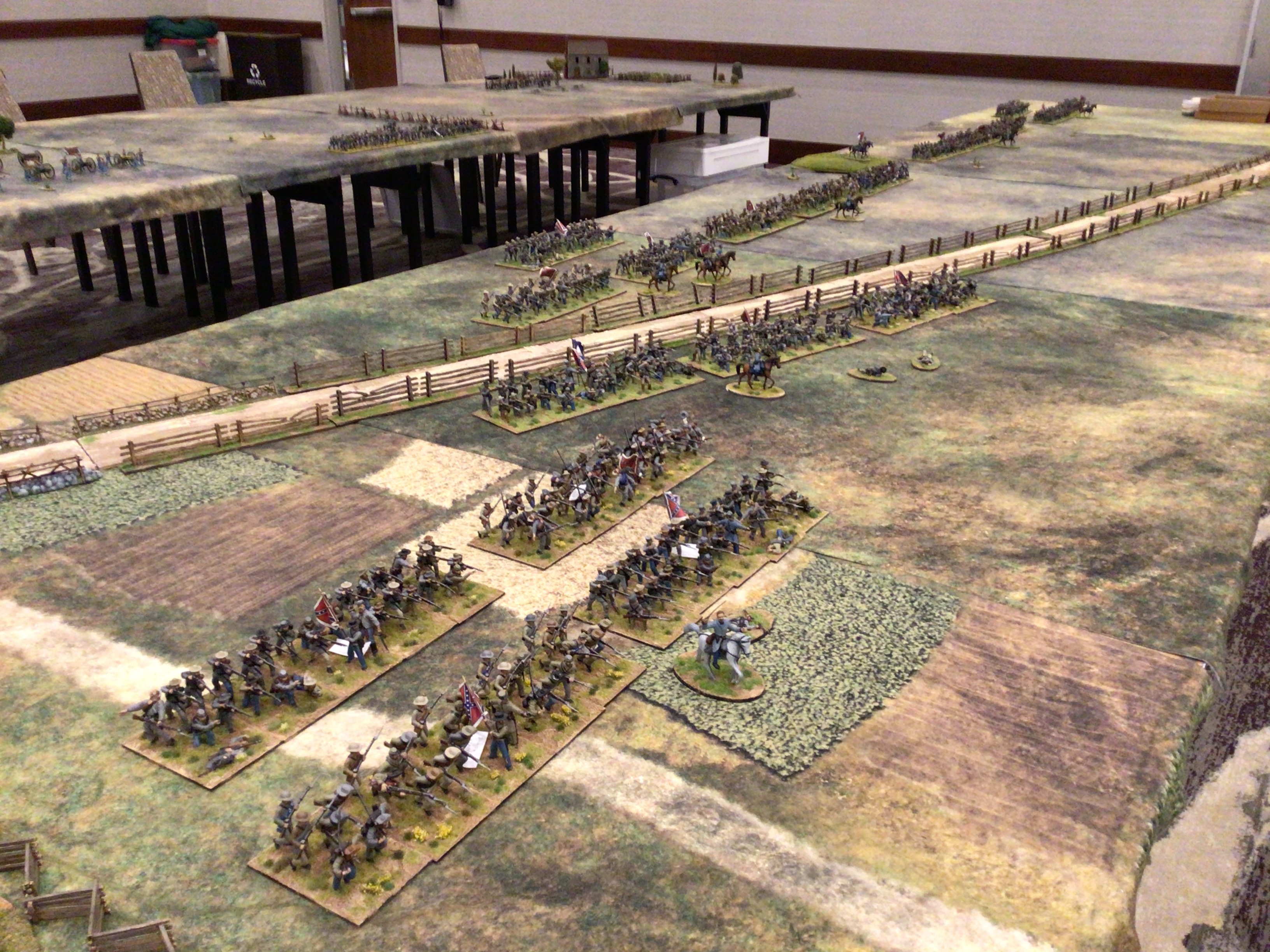
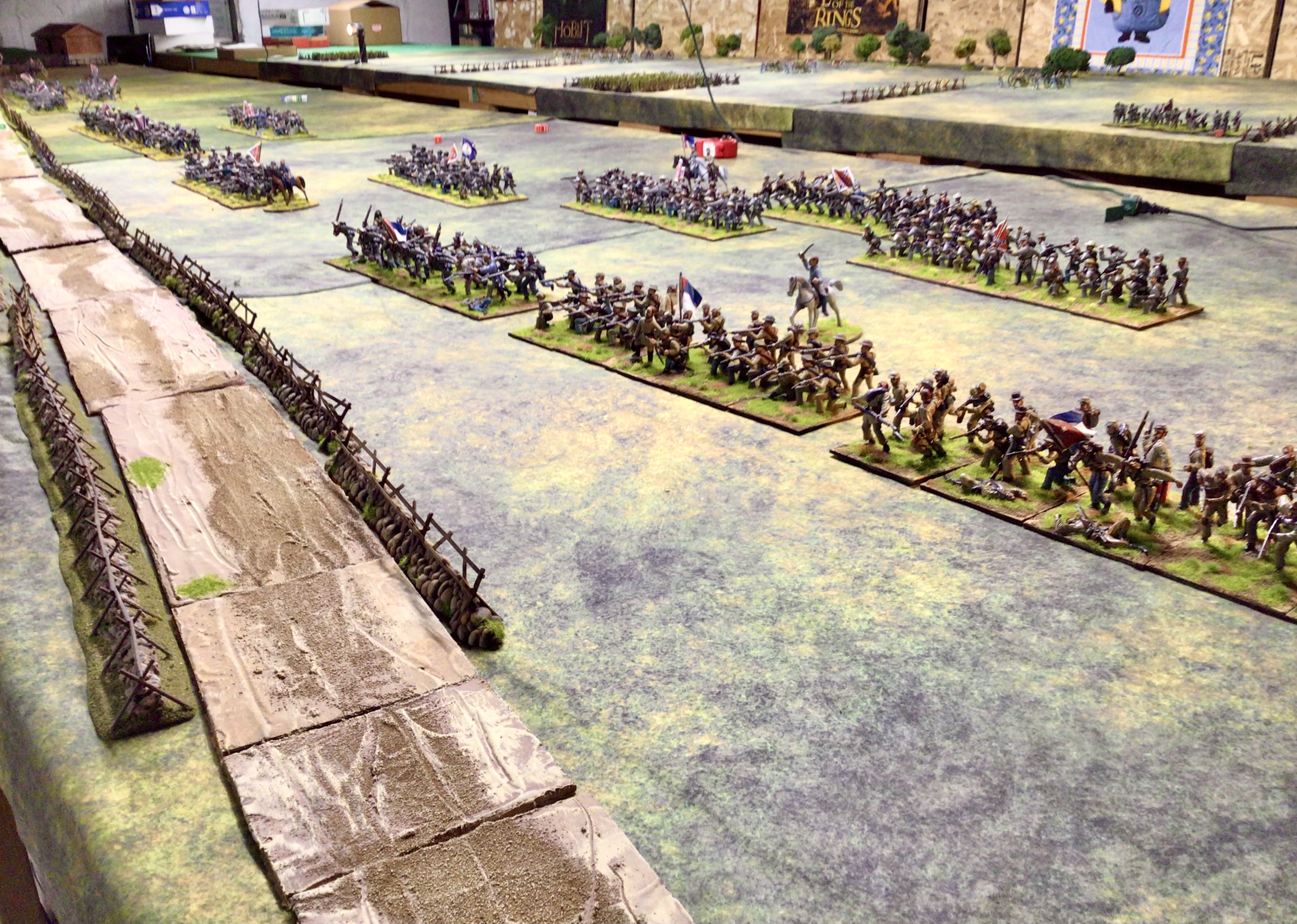
Day Two of the battle of Altenberg commenced with the French deciding that they would need to fall back and form up a defensive position on the back table in their own center and right wings of the army. As noted in yesterday's report, Davout was also holding the defense on the left. So the offensive initiative was ceded to the Allies so that the French could build up their infantry strength.

Duke Siefried commanded the Austrians and Russians in the center and he put on a wargaming clinic on how to use combined cavalry and horse artillery to defeat one's opponent. It was one of the best displays of table top generalship that I had ever seen. It seems like the French were always on the run and Duke never gave them breathing room to recover. There always seemed to be a squadron of cavalry to the front and flank of any French cavalry attack, while the horse artillery was used with deadly precision.


A second French corps arrives in the center (mixed group of Bavarians and French) and occuppy one of the farms in a defensive position. The battery on the right is about to get over run by the Russian cavalry as the French cavalry has abondoned the centre, leaving the French infantry to fend for themselves in square.


The French First Corps in the center holds to its squares, while the cavalry seeks refuge behind them in hopes of reforming.


French cavalry in the center try to reform behind the protective squares of the First Corps.


So at the end of Day Two, the French now have two infantry corps pinned down in the center by hoards of Austrian and Russian cavalry. The French Fourth Corps commander was last seen sending most of his heavy cavalry over to the center to assist his beleagured comrades. I should point out that it was the French plan to consolidate on the back table, but we were a bit surprised by how aggressive the enemy cavalry were. The Austrians are now well screened so that they can bring up their infantry and hold the ground gained by their cavalry. These are not the usual Austrians, my dear Chanticlare.

I will post pictures of the French and British battle on the French right within the next couple of days.

Saturday, May 30, 2009

In The Grand Manner - Day 2


Russian cavalry (21 squadrons) deployed to attack Davout's corps (13 squadrons) at the end of Day One


Davout's defense of the French left at the conclusion of Day 1 (April 19, 2009)

Today we reconvened the In The Grand Manner Napoleonic wargame that started on April 19th. As you may recall, the battle began with cavalry brigades entering the tables from a variety of directions. The French dice rolls resulted in two of three cavalry brigades entering on the same road as well as two of the three infantry corps. So we were sort of bottled up in a bridgehead that was reminiscent of Aspern-Esseling. Some relief was provided by Davout's large corps of 14 battalions and two field batteries entering the table on the far left flank of the French. We concluded Day One with Davout holding onto the high ground for dear life, hoping to buy enough time to get his corps across the river and set up for an eventual attack. Today's post will focus mainly on the fight that occurred in Davout's sector during today's battle.

Opposing Forces

The Russians began the day with a very strong cavalry corps of 21 squadrons, consisting of 7 squadrons of elite cuirassiers, 6 squadrons of hussars, 8 squadrons of those dreaded pig stickers (aka Lancers) and a horse artillery battery of three light guns.

Davout had only 13 squadrons of horse, consisting of 7 squadrons of dragoons, 4 chasseur squadrons and 2 squadrons of lancers. These were all deployed across the river on the Russian side of the table. Their mission was to provide a screen that would enable Davout to cross his corps of 14 infantry battalions, one 12-pd battery (4 guns) and one 6-pd battery (4 guns). Davout deployed all of his artillery on the French side of the river (which was not fordable, so it could only be crossed at one of the two bridges spanning the water) so that it could enfilade any Russian attack on the long ridge that was perpendicular to the Russian cavalry, thereby screening the advancing French infantry. Three infantry battalions had already crossed the river and they were deployed in square, screened further by the ridge and by all of the French cavalry. The Russians could not charge anything on the reverse slope of the ridge because it blocked line of sight. You can not charge what you can not see.


The final positions of the French infantry & cavalry versus the Russian cavalry at the end of Day Two. The columns of infantry in the upper left are the vanguard of the French Old Guard division which are positioned the exploit the exit of the Russian cavalry corps.

Davout commenced Day Two by opening an artillery salvo against the Russian cavalry, with orders to pay particular attention to the cuirassiers, lancers and then hussars, in that order. Several turns of long range artillery reduced the Russian hussar screen and forced two cuirassier squadrons to return to their own lines. This narrowed the Russain advantage from 21 squadrons to 17 squadrons, versus the 13 French squadrons. At this point, Davout ordered the heavy dragoons on his far right to engage the Russian dragoons (another 4 squadrons of which joined in on the assault) and cuirassiers. The French gained a slight advantage in the ensuing melees, forcing a couple more squadrons of cuirassier and hussars off the field.

Now Davout ordered an all out cavalry charge at the remaining Russian cavalry -- and then a wonderful thing happened. A single squadron of French lancers won a melee against a larger and heavier Russian cuirassier squadron, forcing to to flee, but more importantly, pinning the two cuirassier squadrons that were stacked up behind it. The lancers lost nary a trooper. They also rolled an immediate pursuit, which is a good thing. To the lancers left, the French sent in two squadrons of chasseurs against a similar number of Russian lancers. They lost two troopers, but Davout picked the right moment to start rolling hot dice. The French chasseurs downed 6 Russians! The Russian lancers turned and fled, also pinning more Russian cavalry behind them. As for the chasseurs, Lady Luck speaks French today, for the chasseurs rallied on the spot and were thus in a position to ride down the rest of the Russian cavalry, which was either pinned or fleeing. Pictures of the end result can be seen below.


At the end of Day Two, we see the victorious French chasseurs turning back the Russian lancers in the front line. Their retreat will pin the three Russian squadrons behind them To the right of the chasseurs, you can see the French lancers driving off a squadron of Russian cuirassiers. The cuirassiers will pin the two squadrons of lancers behind them when they rout. The French lancers will have an uncontrolled pursuit into a mass of pinned Russian cavalry. French infantry squares can be see atop the key defensive ridge.


The Guard cavalry division plus a regiment of line cuirassiers arrived on the far side of the river on Turn 18. Here you can see the cuirassiers crossing the river to help out the French cavalry in the main fight. They did not arrive in time to cross swords with the Russians, but they are well posisitioned to follow up and send the Russian host on the run.

While all of these glorious events were happening on the main cavalry field, the Old Guard infantry was arriving behind the large wooded area to Davout's right. The Guard cavalry division was also arriving on the French side (the side where the French artillery is deployed) of the river. This caused a division of Russian infantry, attempting to march up the table edge across the river, to pause and fall back. Davout sent the Guard Lancers and Guard Horse Artillery after the Russians, and maintained four or five infantry battalions on the short side of the river to protect the French grand battery. The line cuirassiers and Guard Horse Grenadiers and Chasseurs began to cross the river.

So the day ended with Davout and the Guard poised to push the Russians back onto the middle table. Now that most of the Russian cavalry was fleeing or falling back into walk-about mode for two turns, it would be safe for the infantry to get out of their squares and advance forward. So things look very promising on the French left flank as we head into Day Three, which will be played on June 24, 2009.

As for events in the center (Austrians versus French) and right flank (British versus French), I will post more pictures over the next several days and do my best to tell that story. To put it briefly, the Austrian cavalry commander in the center, the Duke of Siefried, aggressively pushed the French off of the middle table and well back onto the rear table. The Duke put on an impressive display of wargaming skills and had the French on the run in the center. On the far right, the French fell back onto the back table to deploy into a battle line and play defense (which was our plan), enticing the British to advance.

I did not spend much time monitoring the events in the other sectors, for I was too busy tending to affairs on the left. How's that for fog of war? You don't need special rules for FOW when you are playing on 24 foot long tables. You are too busy in your own sector to even notice what is going on elsewhere on the table.